By Guerrilla Marketing
Think about the last ten minutes you spent on your phone. A trainer brand. A meal kit. A bank that wants you to switch. Someone’s holiday. Another trainer brand, or possibly the same one. Dozens of brands, each getting its moment on your screen. Now try to name three of them. Most of us can’t. And that, in ten minutes of scrolling, is the problem facing almost every marketer in Britain today.
When being seen meant winning
For a long time, the rules were simple: get in front of enough people and some of them will buy. Visibility was the prize. Impressions, reach and views were the numbers everyone celebrated, because being seen felt like the hard part. It isn’t any more. Being seen is now the easy part. Being remembered is where brands win or lose.
The numbers behind the scroll
We’re spending more time online than ever. Ofcom’s Online Nation 2024 report found UK adults spent an average of 4 hours 20 minutes online a day, up from 3 hours 41 minutes the year before. For 18 to 24-year-olds, it was just over six hours.
More time on screens, though, doesn’t mean more attention for brands. Professor Gloria Mark of the University of California, Irvine has spent two decades measuring how long people focus on a single screen before switching. In 2003 the average was about two and a half minutes. In studies from 2016 to 2020, it fell to just 47 seconds.
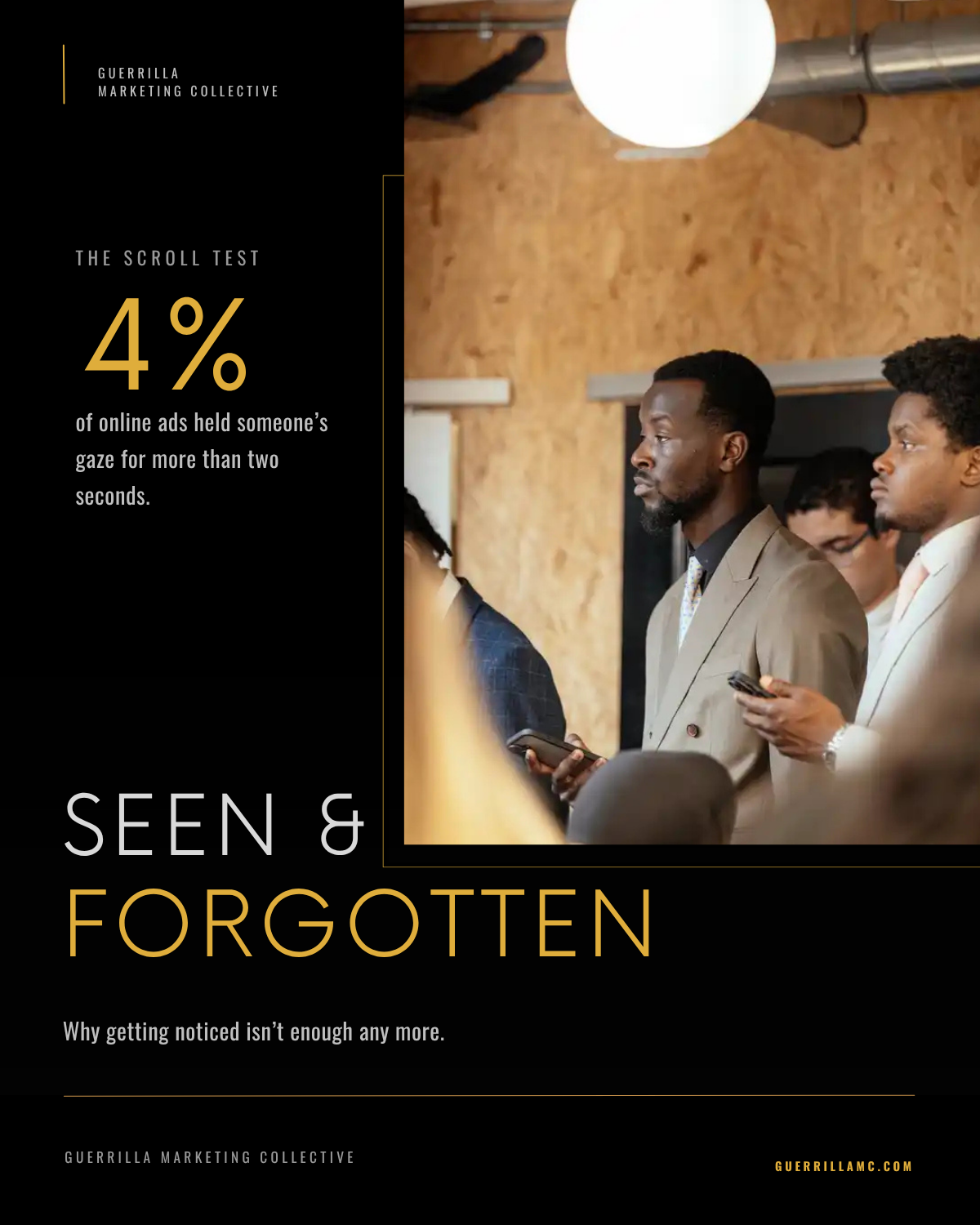
And advertising gets even less. Back in 2016, before feeds became quite as crowded as they are now, research firm Lumen used eye-tracking to follow how 300 people looked at 15,000 online ads. Only 44% of them were looked at at all. Just 4% held someone’s gaze for more than two seconds.
So brands can be on screen, in the feed and fully “viewable” without being noticed at all.
We’re not goldfish. We’re editors.
You’ve probably heard that humans now have a shorter attention span than a goldfish: eight seconds against the goldfish’s nine. It’s a great line, and it’s not true. When BBC reporter Simon Maybin traced the claim back in 2017, he couldn’t find any research behind it. The figures came from a graphic in a 2015 Microsoft Canada report, which cited a commercial statistics website rather than a study.
The truth is more interesting. People haven’t lost the ability to pay attention. Someone who flicks past an ad in a split second can lose an entire evening to a good series or a long conversation with a friend. Attention hasn’t disappeared. People have just become ruthless editors of where it goes. People no longer give their attention away freely. They decide who has earned it.
So what earns it?
Three things keep turning up in the moments people actually remember:
Relevance. Something that speaks to what they care about right now, not what a brand wants to say.
Exchange. A two-way moment where they can ask a question, push back and get a real answer.
A human. You can scroll past a banner. It’s far harder to scroll past a person who’s genuinely interested in what you think.
That last one matters more than ever. A conversation with a real person needs no viewability metric, because you’re either in it or you’re not. And when someone chooses to stop, listen and talk, they’ve given a brand something no algorithm can buy: their full attention, freely given.
Where we come in
At Guerrilla Marketing Collective, this is the idea the whole business is built on. No bots. No banners. Just humans.
We don’t chase impressions. We focus on the conversations that lead to decisions. Our trained brand representatives meet people where they actually are: at festivals, on high streets, in shopping centres and at transport hubs. Then we track every conversation, sample, sign-up and sale, so brands know exactly what that attention turned into.
Because in a world where everyone has been seen, the brands that win are the ones that have actually been heard.
Back on the Tube
Think back to that Tuesday morning commute. Dozens of brands on your screen, and you can’t name three.
Now think of the last time someone stopped you, asked a good question and actually listened to the answer. You probably remember the brand and maybe even what they said.
That’s the difference between being seen and being chosen.
Stop renting attention. Start earning it.
Ready to put your brand in front of people who’ll remember it? Start a conversation with us →